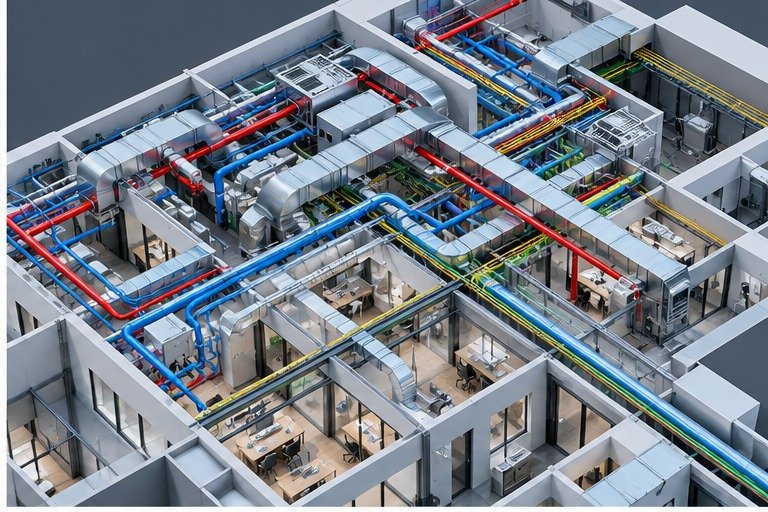
Learn the Core MEP Systems for Data Centers
A practical, project-focused training program covering key design concepts, calculations and real-world application.
Practical learning across the engineering systems that support reliable, mission-critical data center infrastructure.
A practical, project-focused training program covering key design concepts, calculations and real-world application.
Understand the engineering systems used in mission-critical data center projects through technical concepts, design calculations and software workflows.
Review the topics covered across HVAC, fire protection, plumbing and electrical systems for data center applications.
View course dates, module-wise schedules, training hours and session details for our Data Center MEP programmes.
Explore the major engineering disciplines addressed through the Data Center MEP training program.
Understand design fundamentals, technical drawings, space planning and equipment layouts used in MEP projects.
Explore data center cooling systems, heat-load calculations, cooling technologies, equipment selection and HAP workflows.
Study fire protection fundamentals, relevant NFPA codes, pre-action systems, gas suppression and hydraulic calculations.
Understand water demand, tank selection, pipe sizing, drainage, grey-water systems and data center plumbing layouts.
Explore power and lighting calculations, voltage drop, short-circuit calculations, UPS and battery sizing, and ETAP workflows.
Understand project layouts, equipment placement, piping and ducting arrangements, and electrical drawing preparation.
The syllabus brings together core engineering concepts, data center applications, design calculations and practical project exercises.
HVAC fundamentals, data center types, codes and standards, cooling technologies, heat-load calculations, equipment selection, smoke management, CAD drawings and HAP software.
Fire protection fundamentals, NFPA 13, 14 and 20, data center codes, pre-action system design, hydraulic calculations using ELITE software, gas suppression and mist systems.
Plumbing fundamentals, applicable building codes, water supply and drainage, tank calculations, water demand, pipe sizing, grey-water systems and project layouts.
Electrical fundamentals, lighting and power calculations, voltage drop, derating, short-circuit calculations, UPS and battery sizing, ETAP, SLDs and electrical layouts.
The syllabus also includes project examples, drawing exercises, design basis report discussions, practice project inputs and interview-focused Q&A sessions.
Feedback from learners on the clarity, practical approach and real-world relevance of the training.
The course is going really well! The sessions on mission-critical power and cooling are very structured and easy to follow. Loving the practical approach so far.
Sir, to be honest, I always assumed data centre MEP design would be extremely complicated, but the way you break down the terminology and core concepts makes it feel surprisingly straightforward. The clarity across both electrical and mechanical systems has made a huge difference in how I look at mission-critical infrastructure now. Thank you.
Sir, a quick note to say the sessions are going great. I really appreciate how thoroughly you break down complex electrical calculations, fault level analysis, and critical load estimations for data centers. The depth you cover in class is exactly what I was hoping to learn. Thank you.
Thank you, Sir, for your extraordinary teaching. I must admit that I initially thought data centre MEP design would be an extremely complex subject. However, the way you break down technical terminology and explain the fundamental concepts makes it much easier to understand. Your structured approach to explaining both electrical and mechanical systems has significantly enhanced my understanding of mission-critical infrastructure. I truly appreciate the clarity, depth, and practical insights you bring to each topic. Thank you for sharing your knowledge and making such a complex subject more accessible.
I always thought data center electrical system design was very complex, but your way of explaining the concepts makes it easy to understand. Thank you for sharing your knowledge!
The course has been an excellent experience. In particular, the modules on mission-critical power and cooling are exceptionally well-structured and accessible. I very much appreciate the practical, real-world focus of the curriculum.
Build practical confidence through focused training in critical MEP systems, engineering calculations and project-based design workflows.